
Concrete Driveways on Steep Terrain: A Sevierville Guide
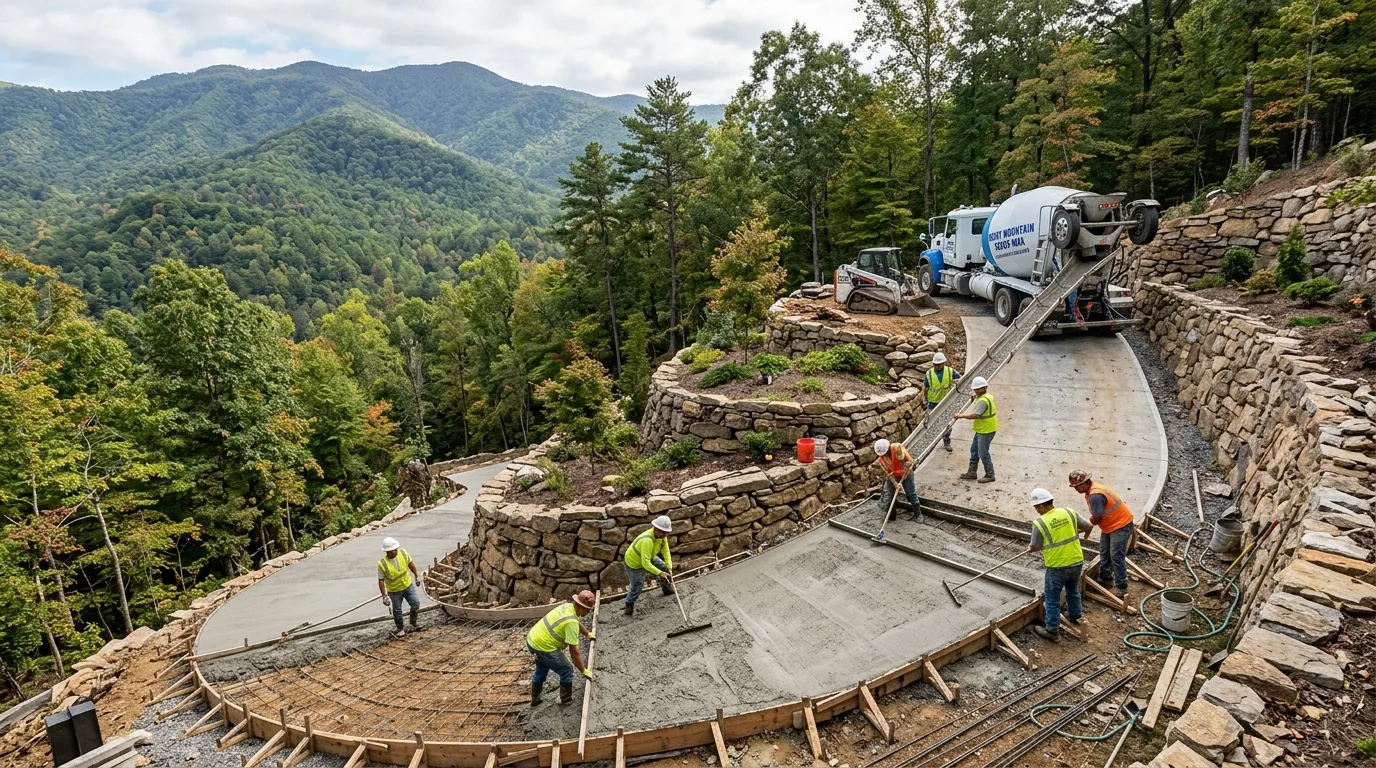
Getting a straight answer on hillside driveway installation in Sevierville is harder than it should be. Most concrete contractors’ websites describe flat-lot work. Most pricing guides don’t account for grade. And most homeowners in the Smoky Mountain foothills don’t realize that a 15% slope changes almost every aspect of how a concrete driveway is designed, formed, and poured. This guide explains what’s actually different about steep-terrain driveway installation in Sevierville — and what to look for in a contractor who can do it right.
In this post, we cover why steep lots change the installation process, what specific techniques handle slope safely, and what questions to ask any contractor bidding your Sevierville hillside driveway.
Hillside Driveway Installation in Sevierville
We specialize in steep-terrain concrete driveways throughout Sevier County. Free estimates that account for your actual lot conditions. Call (888) 376-0955.
Why Steep Terrain Changes the Concrete Driveway Equation
A driveway on a flat lot involves site prep, forming, pouring, and finishing on level or near-level ground. A hillside driveway in Sevierville adds a cascade of additional considerations that most generic concrete guides never address.
Forming on grade. Setting forms on a steep slope requires additional bracing to prevent movement during the pour. The forms must maintain consistent slope along the driveway length while also managing the cross-slope for drainage — typically a 2% cross-slope toward the low side. Getting this geometry right on a 12–18% grade requires experience that flat-ground concrete work doesn’t develop.
Rocky sub-base. Properties in Sevier County’s hillside neighborhoods — including areas near Gatlinburg and throughout the Smoky Mountain foothills — often have rocky compacted sub-base material that must be excavated and replaced with appropriate aggregate base material. Rocky sub-base is not automatically stable: loose rock creates uneven bearing that leads to slab cracking. Proper excavation and compacted base installation is essential.
Drainage management. Water running down a steep driveway toward the garage or structure is a serious drainage failure. Proper hillside driveway design includes cross-slopes that direct runoff to the side, channel drains or French drains at transition points, and grade breaks that prevent water velocity from building up and eroding the driveway edges.
Concrete delivery. Ready-mix trucks have limited maneuverability on steep residential roads. Many Sevierville mountain properties require pump trucks or extended chutes to reach the pour location — planning for access is essential before scheduling the pour.
Key Design Elements for Hillside Driveways in Sevierville
Traction finish. A standard broom finish may not provide adequate traction on grades above 10% in wet conditions. A deeper broom texture, transverse scoring at regular intervals, or exposed aggregate finish provides the traction grip needed on steeper Sevierville driveways. This is especially important for driveways that also serve as pedestrian access on steep lots throughout Sevier County.
Thicker sections at grade breaks. Where the driveway transitions from steep grade to relatively flat (at the garage apron, at the street, or at a landing area), the slab experiences higher stress concentrations. Thickening the slab to 6 inches at these transitions — compared to the standard 4-inch thickness on straight sections — reduces the risk of cracking at these stress points.
Control joint placement. Hillside driveways require thoughtful control joint layout. Joints on slopes cut at intervals perpendicular to the slope direction give natural concrete cracking a directed path that maintains drainage and doesn’t create tripping hazards. Random cracking on slopes without proper joint placement creates uneven edges and water-collecting channels.
Retaining walls at driveway edges. On steep lots where the driveway is built into a hillside cut, the uphill edge often requires a concrete retaining wall or curb to hold the cut back from the driveway surface. This is especially common on properties in the Knife Works Area and throughout Sevier County’s steeper residential neighborhoods.
Your Sevierville Hillside Driveway Done Right
We assess steep lots, plan access, and install driveways that last in Sevier County's mountain terrain. Call (888) 376-0955 for a free estimate.
Questions to Ask Before Hiring a Hillside Driveway Contractor
Before signing any contract for a steep-terrain driveway in Sevierville, ask:
- How will you handle drainage at the base and top of the slope? The answer should mention cross-slopes and drainage channels or French drains — not just “we’ll make sure water runs off.”
- What’s the minimum concrete thickness you specify for slopes above 10%? The answer should be 4–5 inches minimum, with thickening at grade breaks.
- What finish will provide adequate traction on this grade? The answer should go beyond “standard broom finish” for slopes above 10%.
- How will ready-mix trucks access this site? If they haven’t thought about this, they haven’t been on hillside lots much.
- Have you done similar driveways in Sevierville or on comparable terrain in Sevier County? Ask for specific examples.
A contractor who gives specific, confident answers to these questions understands hillside work. One who gives vague or generic answers is likely to treat your sloped lot like a flat one.
Cost Differences for Hillside Driveways in Sevierville
Expect to pay 15–30% more for a steep-terrain driveway compared to a flat-ground pour of the same square footage. The additions that justify this premium include: extended forming labor, sub-base excavation through rocky soil, drainage integration, traction finish, thickened transition sections, and pump truck access if standard truck access is limited.
Sevierville’s $9–$10 per square foot standard for driveway installation applies to relatively straightforward sites. Steep hillside lots in Sevier County — particularly in the Gatlinburg area and throughout the upper county foothills — can run higher depending on specific site conditions. See our 2026 concrete cost guide for Sevierville for full pricing context.
Frequently Asked Questions
What slope is too steep for a concrete driveway in Sevierville?
Concrete driveways up to 20–25% grade are generally feasible with proper design — traction finish, drainage planning, and thickened sections at grade breaks. Beyond 25%, vehicle traction and drainage management become challenging. Properties with extreme grades sometimes require tiered driveway approaches with level landing areas between sections. We assess grade during site visits and advise on what’s feasible for each specific Sevierville lot.
Do steep driveways need extra concrete thickness in Sevierville?
Standard residential driveways use 4-inch thickness. Hillside driveways in Sevierville benefit from 5 inches on steep sections and 6 inches at grade transitions. The additional thickness adds marginal material cost but significantly improves resistance to cracking at stress concentration points. For heavier vehicles — trucks, RVs — 5–6 inch thickness across the full pour is recommended regardless of slope.
What happens if drainage isn’t handled on a steep driveway?
Without proper drainage design on a Sevierville hillside driveway, water follows the slope directly toward the garage, structure, or foundation. Over time, this creates moisture intrusion at the garage door threshold, soil erosion at driveway edges, and eventual undermining of the slab base. Drainage integration is not optional on slopes — it’s a structural requirement for long-term driveway performance. See our full guide to concrete driveways in Sevierville.
Related: