
How Expansive Clay Soil Affects Concrete Slabs in Sevier County
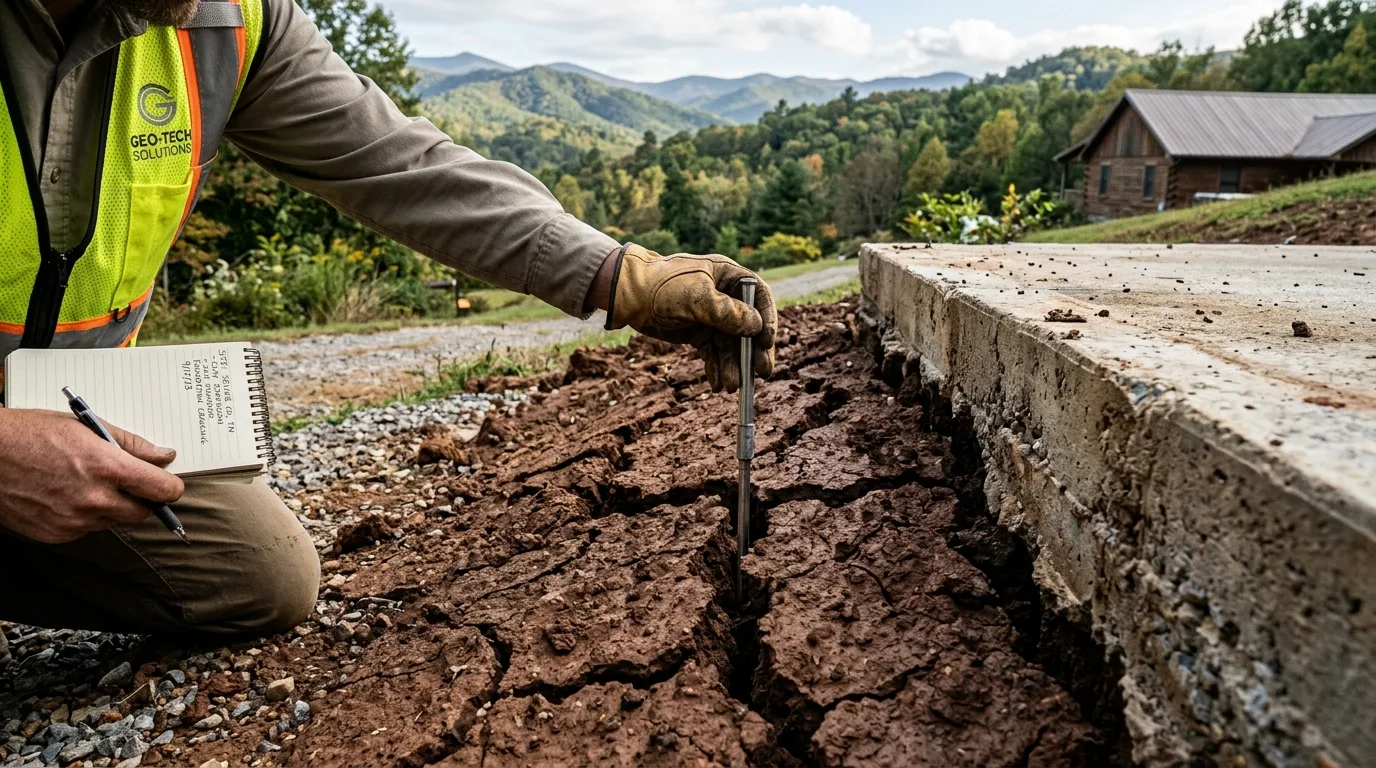
Sevier County homeowners who have watched their driveways, patios, or garage slabs develop cracks that seem to open and close with the seasons are probably dealing with expansive clay soil beneath the concrete — not just weather damage. Clay soil concrete problems in Sevierville are distinct from freeze-thaw cracking; they follow a different pattern, respond to different conditions, and require different repair approaches. Understanding which problem you’re dealing with determines the right solution and prevents wasted money on repairs that don’t address the actual cause.
In this post, we cover what expansive clay is and why it exists in Sevier County, how it damages concrete slabs differently from freeze-thaw cycling, and what installation and repair approaches actually work on clay-heavy lots.
Clay Soil Concrete Assessment in Sevierville
We assess sub-base conditions before every project to spec the right solution for your lot. Free estimates across Sevier County. Call (888) 376-0955.
What Expansive Clay Soil Is and Where It Exists in Sevier County
Expansive clay — including the bentonite clay common in Sevier County’s Smoky Mountain foothills — is a soil type that changes volume significantly with moisture content. When clay absorbs water, it swells. When it dries out, it contracts. For a concrete slab sitting on this soil, that means the ground beneath it is constantly moving — slowly, but enough to crack and shift concrete over years of seasonal moisture cycling.
The volume change in expansive clay soils can be dramatic: high-plasticity clay can swell up to 15% in volume when fully saturated. A 6-inch clay layer expanding by even 5% exerts enough upward pressure to crack a residential concrete slab from below. When the clay subsequently dries and contracts, the slab drops back — but not necessarily to the same position, because the concrete has already cracked and shifted.
In Sevier County, expansive clay occurs most commonly below the rocky near-surface layer characteristic of the mountain foothills. This creates a deceptive situation: the top few feet of a Sevierville lot may be rocky compacted material that seems stable, while the underlying soil profile includes clay layers that drive long-term slab movement.
How Clay Damage Differs from Freeze-Thaw Cracking
This distinction matters for diagnosis and repair. Clay-driven concrete damage has characteristic patterns that differ from freeze-thaw damage:
Seasonal opening and closing. Cracks in clay-affected concrete tend to be wider in summer (dry season, clay contracted) and narrower in winter (wet season, clay swelled). Freeze-thaw cracks, by contrast, are often widest after winter. If your cracks change noticeably with the seasons and the change correlates with dry vs. wet periods rather than freeze vs. thaw, clay movement is the more likely driver.
Long, diagonal cracking patterns. Clay soil movement often produces diagonal cracks extending from slab corners — the corners are the least constrained points and move most when the sub-base shifts. Freeze-thaw cracking tends to run perpendicular to the slab edge or follow control joint lines.
Panel settlement or heaving without adjacent damage. A single panel that settles or heaves while neighbors remain flat often indicates localized clay variation beneath — one area has more clay than the other. Freeze-thaw damage is more uniform across a surface of similar age and installation quality.
No surface spalling or pitting. Clay-driven slab movement doesn’t produce the surface texture damage (spalling, pop-outs) characteristic of freeze-thaw distress. If a slab has cracked but has a smooth, intact surface, clay movement is more likely than climate damage.
Concrete Slab Diagnosis in Sevierville
Cracked slabs in Sevier County often have soil causes, not just climate causes. We identify what's driving the damage before quoting repairs. Call (888) 376-0955.
How Clay Soil Problems Are Prevented at Installation
The best time to address expansive clay in Sevier County is before the slab is poured. Proper sub-base preparation for clay-heavy lots involves:
Over-excavation and granular fill replacement. Removing clay to a depth of 12–18 inches and replacing it with compacted granular fill (crushed stone, decomposed granite, or engineered fill) provides a stable, non-expansive bearing surface. The granular fill drains freely, preventing the moisture accumulation that drives clay volume changes.
Moisture barriers. A vapor barrier beneath the granular fill prevents sub-surface moisture from wicking upward into the bearing zone. Combined with proper site drainage that directs surface water away from the slab perimeter, moisture barriers significantly reduce clay activation beneath concrete.
Increased slab thickness and reinforcement. Where clay soil cannot be fully mitigated — deep clay profiles or projects where full excavation isn’t feasible — increased slab thickness (5–6 inches rather than 4) and post-tensioning or engineered rebar layouts distribute load across the slab to resist cracking when minor sub-base movement occurs.
Pre-saturation. Some engineers specify wetting the clay sub-grade before pouring to pre-swell it — the theory being that if the clay is already saturated during installation, subsequent wetting won’t cause expansion. This approach is site-specific and only appropriate under certain soil conditions; it’s not a universal solution.
Repair Options for Clay-Damaged Slabs in Sevierville
For concrete slabs in Sevierville that are already cracked from clay soil movement, repair options depend on the severity of movement and the condition of the slab:
Mudjacking or polyurethane lifting: For slabs that have settled due to clay contraction, injecting material beneath the slab (either traditional grout mix or expanding polyurethane foam) can lift the panel back to grade. This addresses settlement but not the underlying clay issue — clay movement continues unless drainage is corrected.
Drainage correction: The most durable long-term fix for clay-affected slabs is correcting the drainage conditions that keep activating the clay. This may involve regrading the surrounding lot, installing French drains to intercept sub-surface moisture, or extending downspouts away from the slab perimeter.
Full panel replacement with sub-base correction: For slabs with advanced cracking and significant settlement, panel replacement with proper sub-base excavation and granular fill provides the most durable repair. See our concrete repair service page for full options.
Frequently Asked Questions
How do I know if my Sevierville concrete is cracking from clay soil or freeze-thaw?
Look at the crack pattern and seasonal behavior. Clay-driven cracks often open in summer dry months and narrow in winter; freeze-thaw cracks are worst in spring after winter cycling. Clay damage produces long diagonal cracks and panel settlement without surface spalling. Freeze-thaw damage shows surface pitting, flaking, and D-cracking near slab edges. For a definitive assessment, we inspect both the slab surface and sub-base conditions. See our guide on signs your Sevierville concrete needs repair for damage identification detail.
Does clay soil affect all concrete in Sevier County?
Not uniformly. Clay distribution in Sevier County’s soil profile varies significantly across lots. Some properties in Seymour and Dandridge have deep clay profiles; others in the rocky upper foothills have minimal clay. The only way to know your specific lot’s soil profile is a site assessment — visual surface inspection doesn’t reveal what’s 18 inches down.
Can I pour a concrete slab over clay soil in Sevierville without fixing the soil first?
You can, but the slab will almost certainly crack and move over time. The only scenario where pouring over clay without sub-base correction is reasonable is a temporary or expendable slab — a pad you expect to replace in 10 years. For permanent residential concrete — driveways, patios, garage slabs — sub-base correction is worth the additional cost. The difference between proper sub-base preparation and a slab replacement in 8 years is usually a net savings. See our concrete foundations page for information on foundation design in clay-heavy soil.
Related: